
Is online casino play legal in Malaysia? What the 1953 law says in 2026
No. No Malaysian authority issues a licence to run an online casino. The only casino licence the law provides for is granted by the Minister of Finance to a Malaysian company, for named premises, for no more than three months at a time[1]. In 2023 the Court of Appeal held that gambling on computers is covered by the Common Gaming Houses Act 1953 even when no physical gaming equipment is present[2], and in September 2026 magistrates in Kuching fined people between RM2,000 and RM2,700 for playing casino games on their phones[3][4].
The short answer, depending on who you are
The law treats three groups differently, and most guides blur them together.
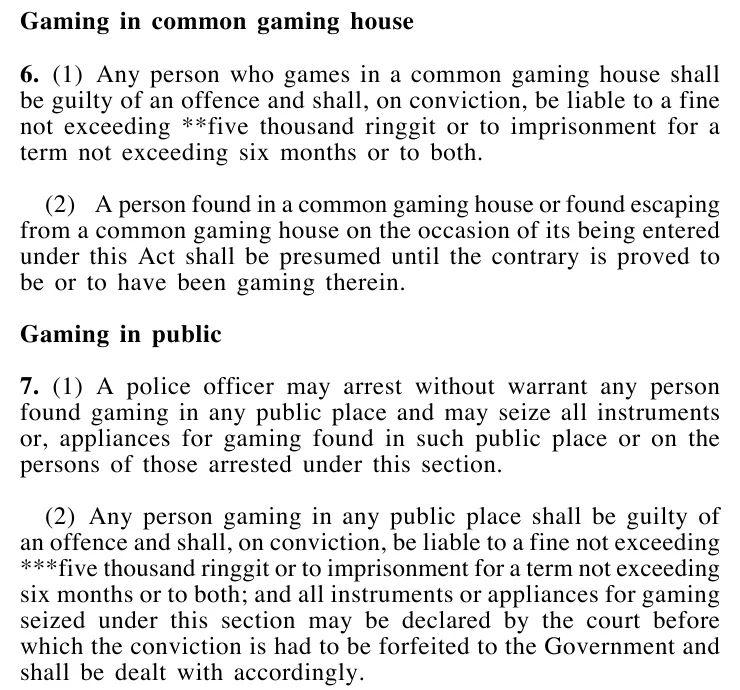
- Players. Gaming in a common gaming house carries a fine of up to RM5,000, up to six months in prison, or both. Gaming in a public place carries the same maximum[1]. Players have been convicted under both kinds of charge in reported cases[2][3].
- Muslim players. A separate Syariah offence applies on top of the civil law. In the Federal Territories it carries a fine of up to RM3,000, up to two years in prison, or both, and it covers gambling whether or not another law permits the game[5].
- Operators, agents and promoters. Keeping or managing a common gaming house, or publishing that one is open and inviting people to game there, carries a fine of RM5,000 to RM50,000 and a prison term of up to three years[1]. These penalties are far heavier than the ones players face.
None of this changes because a website is hosted abroad or holds a licence from another country. A foreign licence is a matter between the operator and its own regulator. It gives a Malaysian player no permission under Malaysian law. The rest of this page sets out where each of those statements comes from, so you can check them yourself.
What the Common Gaming Houses Act actually says
The Act was first passed in 1953 and revised in 1983. The text we quote is the official reprint published by the Attorney General’s Chambers, which incorporates amendments up to 1 January 2006[1]. Parliament can amend an Act after a reprint is published, so penalty figures in particular should be checked against the current text before you rely on them for anything that matters.
Three definitions in section 2 do most of the work for online gambling:
- “Gaming” means playing any game of chance, or of mixed chance and skill, for money or money’s worth. The definition expressly includes “the playing or operation of any gaming machine”.
- “Gaming machine” means any mechanical, electrical or electronic machine or device, “including any computer program used in such machine or device”, that can be used to play a game of chance and through which winnings may become payable. A phone or laptop running a casino app fits that wording.
- “Common gaming house” includes any place kept or used for gaming to which the public has access, any place kept for habitual gaming, and any place where eight or more people are gaming or a bankers’ game is being played. “Place” is defined widely: any house, room, building or spot, open or enclosed, and even a vehicle or boat.
The offences then follow. Under section 6, anyone who games in a common gaming house commits an offence. Under section 7, anyone gaming in any public place commits an offence, and a police officer may arrest them without a warrant and seize the “instruments or appliances for gaming”, which includes gaming machines. Section 7 also presumes that anyone using money in a game of chance in a public place is gaming, unless they prove otherwise[1].
Section 4 covers the people who run or assist a common gaming house. Its paragraph (g) also catches anyone who “announces or publishes” that a place is open as a common gaming house, or “in any other manner invites or solicits any person” to game in one. Section 8 separately punishes anyone who “instigates, promotes or intentionally facilitates” gaming in a public place, with a fine of RM20,000 to RM200,000 and up to five years in prison[1]. Those two provisions are the reason this site does not link to any operator.
The 2023 Court of Appeal ruling
On 18 October 2023 a three-judge bench of the Court of Appeal, chaired by Justice Vazeer Alam Mydin Meera, decided an appeal arising from a 2017 raid on a condominium in Melaka[2]. Two people had been convicted in the magistrates’ court in 2020:
- a retired policeman charged under section 6(1) with playing roulette at an online casino on a laptop, with nine others said to be at large;
- the manager of the premises, who had 26 laptops under her control, charged as the person managing it.
The defence argued that the Act needs physical gaming equipment, such as a roulette wheel, ball and staking board. The prosecution argued that “gaming machine” includes any electronic device or computer program, so the laptops qualified. The court sided with the prosecution. It held that it was enough to show that gambling had taken place using computers, and it dismissed both appeals[2].
Two limits are worth stating plainly. First, the case concerned a group of people gambling together at premises that were being managed for that purpose, which is the classic common gaming house. Second, the report we read describes the ruling as settling the law in Peninsular Malaysia[2]. Neither point makes a lone player at home safe. They simply mean the case does not answer every situation.
Players fined in 2026
The 2026 cases show the law being used against individual players with phones, not only against dens and operators. All of the cases below were heard by magistrates in Kuching, Sarawak:
- 7 September 2026: a 55-year-old man was fined RM2,700, with three months in prison if unpaid, under section 7(2). Police had found him on the five-foot way of a café on Jalan Stutong playing a slot game on the 918Kiss site on his phone. He also had a slip of paper carrying what police believed was a gambling ID and password. A gambling expert later confirmed the computer-gambling elements[3].
- 22 September 2026: a 36-year-old man pleaded guilty to a section 7(2) charge and was fined RM2,500, with two months in prison in default. Police had checked his phone near a café and found a game running on the Mega888 website[4].
- 25 September 2026: a 54-year-old man was fined RM2,000, with two months in prison in default[4].
- A further case reported in the same period involved a 42-year-old man fined RM2,500 for using the 918Kiss app. There, the court heard that the games depended on chance and needed no particular skill[4].
The pattern in these reports is consistent. The person was in a public place, police inspected the phone, and an expert report confirmed that the app or site was a game of chance with payable winnings. Two practical points follow. First, playing on a phone in a café or food court is gaming “in a public place”. Second, the phone itself can be seized as an appliance for gaming[1].
The Syariah layer for Muslim players
For Muslims, gambling is also a Syariah criminal offence, enforced by state religious authorities alongside the civil law. Each state has its own enactment. In the Federal Territories, section 18 of the Syariah Criminal Offences (Federal Territories) Act 1997 makes it an offence for any person to gamble, or to be found in a gaming house, with a fine of up to RM3,000, up to two years in prison, or both[5].
The definition of “gaming house” in that section covers any premises used for a game of chance, or of chance and skill, for money “whether permitted by any other law or otherwise”[5]. In other words, a licence held by a casino, at home or abroad, does not take a game outside the Syariah offence. Penalties and wording differ between states, so a reader outside the Federal Territories should check the enactment of their own state.
What the law does allow, and why none of it is online
The Act carves out one route for casino gaming. Section 27A lets the Minister of Finance, at his discretion, license a company registered in Malaysia, other than a foreign company, to promote and organise gaming. The licence names the games, the premises, the fees and duties, and other conditions. It lasts no more than three months and may be renewed for periods of no more than three months each. The Minister may revoke or change it at any time, and breaching its terms carries a fine of up to RM50,000, up to seven years in prison, or both[1].
Everything about that route is tied to a Malaysian company and to specified premises. There is no equivalent route for a website, and no Malaysian regulator publishes a list of approved online casinos, because there are none to list. When a site tells Malaysian visitors it is “licensed” or “legal”, the licence it means is foreign. If you want to understand what such a licence is worth, our guide on how to check an offshore casino licence yourself walks through each regulator that commonly appears on Malaysia-facing sites.
Blocking, takedowns and the mirror-site problem
The Malaysian Communications and Multimedia Commission (MCMC) asks internet providers to block gambling sites and asks platforms to remove gambling content. In a written parliamentary reply published on 16 July 2026, the Communications Ministry reported the following figures for 1 January 2025 to 31 May 2026[6]:
- providers had taken down 457,562 gambling-related items, about 98% of 467,772 requests;
- internet providers had blocked 1,778 gambling websites at the MCMC’s request.
Blocking is why many brands that market to Malaysians move between a string of alternative domains. Scammers can copy the same pattern, so a reader cannot tell a brand’s new domain from a copy of it just by looking. That problem comes up again and again in our licence checks of the brands Malaysians search for. A licence claim only means something if the regulator’s own register ties it to the domain you are actually looking at.
The new online gambling law being drafted
The government has said the 1953 framework needs replacing. In January 2026 the Home Minister told the Dewan Rakyat that police had proposed reviewing the law, including:
- amending the Common Gaming Houses Act;
- adding online gambling offences to a proposed Cyber Crime Bill.
On 15 February 2026 the Deputy Prime Minister said a new law to curb online gambling was being drafted. He said it could be a new Act or amendments to existing ones, and that it might be tabled at the next sitting of the Dewan Rakyat, depending on whether the bill was ready[7].
When we checked on 28 October 2026, we found no report that the bill had been tabled or passed. The 1953 Act therefore remains the law that is being enforced, as the Kuching cases show[4]. We will update this page when a bill is published. A new law is expected to strengthen enforcement, not to create a licence for online casinos[7].
What an offshore licence does and does not do for you
An offshore licence is still worth checking, for a narrow reason. It tells you which regulator, if any, has power over the operator, and whether that regulator offers any complaint route at all. It does not make playing lawful in Malaysia, and it does not give you a Malaysian court or regulator to turn to if a withdrawal is refused.
Some licence claims are weaker than they look. The Philippines, once a common source of licences on Asian-facing sites, ordered all offshore and internet gaming licensees to stop operating by 31 December 2024. The same order said licences would not be renewed or extended[8]. A Malaysia-facing site that still shows a Philippine offshore licence is showing something that no longer authorises offshore play. Before you put any money into any site, read the questions in our guide to gambling help and self-protection in Malaysia. They take five minutes and cover the risks this page cannot.
Questions readers ask
Is it illegal to play online casino games in Malaysia?
Yes. No Malaysian authority licenses online casinos. The Court of Appeal held in 2023 that the Common Gaming Houses Act 1953 covers gambling on computers, and in September 2026 Kuching magistrates fined individual players RM2,000 to RM2,700 for playing on their phones in public places.
What is the penalty for online gambling in Malaysia?
For a player, gaming in a common gaming house or in a public place carries a fine of up to RM5,000, up to six months in prison, or both, under the 2006 official reprint of the Act. Muslims can also face a Syariah charge; in the Federal Territories that is up to RM3,000, up to two years, or both.
Does a Curaçao or other foreign licence make a site legal in Malaysia?
No. A foreign licence only means a foreign regulator has some authority over the operator. It gives no permission under Malaysian law, and it gives a Malaysian player no Malaysian route to complain if a payment goes wrong.
Can I be arrested for playing on my phone in a café?
Yes. Section 7 of the Act lets police arrest without a warrant anyone found gaming in a public place and seize the instruments of gaming. The 2026 Kuching cases began exactly this way, with police inspecting phones at cafés.
Is Malaysia making a new online gambling law?
The government said in February 2026 that a new law was being drafted, either as a new Act or as amendments to existing laws. When we checked on 28 October 2026 we found no report that it had been tabled or passed, so the 1953 Act is still the law being enforced.
Sources
Every source below was read on the date shown. Operator pages are named but not linked: this site does not link to gambling operators.
- Common Gaming Houses Act 1953 (Act 289), official reprint incorporating amendments up to 1 January 2006. Attorney General’s Chambers of Malaysia, Laws of Malaysia. Read on 28 Oct 2026.
- Online gambling an offence under existing law, rules court (18 October 2023). Free Malaysia Today. Read on 28 Oct 2026.
- Man fined RM2,700 for online gambling at cafe (7 September 2026). Sarawak Tribune. Read on 28 Oct 2026.
- Malaysia’s 73-year-old gambling law is being used to prosecute smartphone users (7 October 2026). The Rakyat Post. Read on 28 Oct 2026.
- Syariah Criminal Offences (Federal Territories) Act 1997 (Act 559), official reprint. Attorney General’s Chambers of Malaysia, Laws of Malaysia. Read on 28 Oct 2026.
- Over 450,000 online gambling posts removed, 1,778 websites blocked since January 2025 (16 July 2026). The Star, reporting Bernama. Read on 28 Oct 2026.
- New law being drafted to curb online gambling (15 February 2026). Free Malaysia Today, reporting Bernama. Read on 28 Oct 2026.
- Executive Order No. 74, s. 2024: immediate ban of Philippine offshore gaming, internet gaming and other offshore gaming operations. Supreme Court of the Philippines E-Library. Read on 28 Oct 2026.